

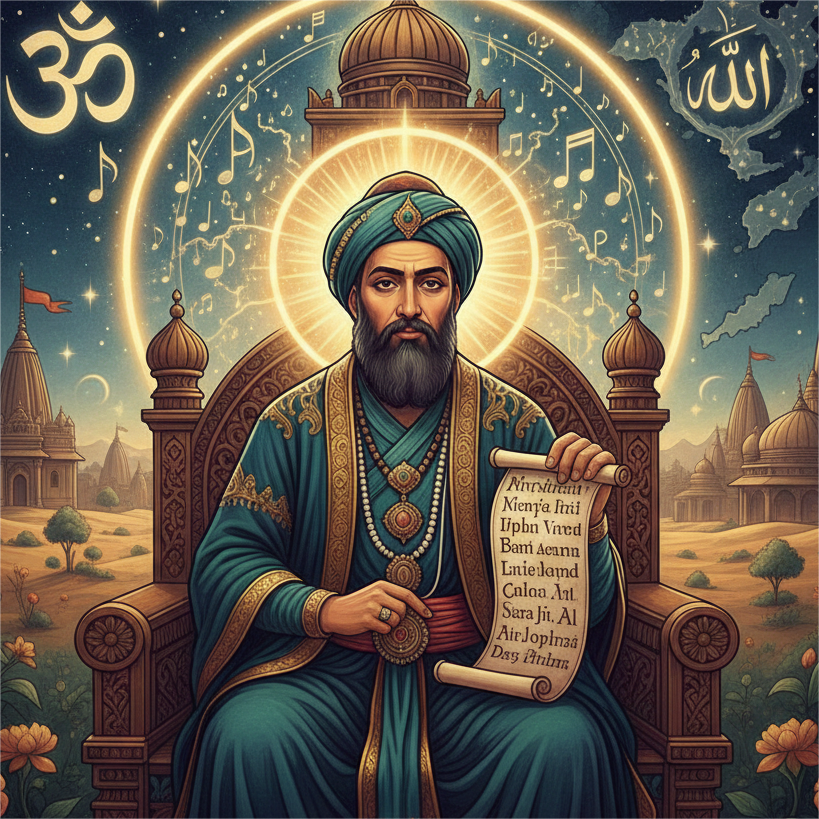
I. Origins and Early Life: From Sebzewar to the Indus
A Sacred Lineage
Pir Sadruddin was born in Sebzewar, Persia (now Iran), likely around 700 AH/1300 CE. His name was Muhammad, and he came from an esteemed lineage of Sayyids who linked their heritage to the Prophet Muhammad via the sixth Imam, Ja'far al-Sadiq.
His lineage demonstrates a heritage of spiritual leadership:
Father: Pir Shihabuddin, who is also referred to as Sahebdin, a well-known missionary in his own right.
Great-Grandfather: The esteemed Pir Shams Sabzewari, who earlier founded a significant Ismaili community in Multan and Sindh.
Learning and Spiritual Readiness
Raised in the intellectual and mystical atmosphere of Persia, Sadruddin obtained a classical education that delved deeply into the essence of religious practice. He was "immersed in a deep comprehension of the mystical doctrine and the Islamic knowledge of tawil" (esoteric interpretation).
Prior to starting his significant journey to India, he undertook the pilgrimage to Mecca multiple times, gaining a proficient command of Arabic and a profound understanding of the fundamental tenets of Islam. These years of preparation were essential; they equipped him with the "hard shell" of Islamic law and theology that he would eventually "soften" to connect with the hearts of the Indian populace
II. The Indian Mission: A Strategy of Synthesis
Pir Sadruddin reached India circa 734 AH/1335 CE, first becoming part of the mission initiated by Pir Shams. His directive, given by the 30th Ismaili Imam, Islam Shah, was to broaden the Dawa (mission) throughout the northern and western areas of the subcontinent.
The Approach of Gradualism
Contrary to many of his contemporaries, Pir Sadruddin did not insist on an abrupt or drastic separation from history. He realized that faith is a process, not an abrupt jump. His mission involved a three-stage conversion process:
The Formative Stage:
In this initial phase, disciples were given ethical and moral teachings through a simple understanding of the Satpanth (True Path). Pir Sadruddin used local dialects and familiar terms from the prevalent social customs to explain Islamic concepts, such as Alakh Nirinjan for the Ineffable God, Guru Bharma for the Prophet, and Nar Naklank for Ali.
The Esoteric Stage:
Once grounded in ethics, disciples reached a second stage where they were entrusted with a "solemn word" (Guru Mantra or Sat Shabada) for private midnight meditation. During this stage, the theory of Das Avatara (Ten Incarnations) was fully elaborated, integrating the Shi'ite doctrine of the Imamate into a Vaishnavite Hindu framework to show the Imam of the time as the spiritual fulfillment of the Indian tradition.
The Sufic Stage:
In the concluding phase, following the mastery of earlier stages, disciples were introduced to authentic Sufic doctrines and practices intertwined with Shi'ism. The focus stayed on complete immersion in meditation, which ultimately granted the devotees the name Khoja, translating to "to become absorbed."
Geographic Scope
Pir Sadruddin's undertaking was marked by significant journeys and a deliberate geographical emphasis that reinforced the Ismaili presence in various vital areas of the Indian subcontinent
Sindh:
Sindh served as a central focus for Pir Sadruddin’s "accelerated mission".
Targeted Communities: He concentrated significantly on the Lohana and Bhatia communities, especially in the Thatta district.
Lower Sindh to Karachi: His journeys ranged from Uchh to lower Sindh, extending to the regions next to the Indian Ocean and the vicinity of present-day Karachi.
The Initial Convert: Local lore indicates that when he arrived in interior Sindh, he first converted the owner of a camel he had employed for his journey
Gujarat and Kutch:
He rejuvenated previous communities and attracted new adherents, traveling through villages to offer a "fresh start" to individuals in spiritual uncertainty.
Kashmir and Punjab:
He constructed prayer spaces and also a tomb for his forebear, Pir Shams, in Multan
III. The Emergence of the Khoja Identity
One of Pir Sadruddin’s most significant legacies is the establishment of the Khoja community. The word "Khoja" is an etymological development of the Persian term Khwaja, which translates to "Lord," "Master," or "Nobleman."
Social Ascension
By granting this title to the recently converted Lohanas, Pir Sadruddin executed a significant act of social engineering. The title substituted their conventional Hindu caste titles such as Thakur. This was more than a mere name alteration; it was a psychological uplift that provided a feeling of dignity and collective pride to a merchant class now united by a newfound, common spiritual identity.
The Organization of the Jamatkhana
To support this new community, Pir Sadruddin set up the inaugural Jamatkhana (prayer-hall) in the village of Kotda (Punjab). Prior to this, adherents typically engaged in their practices in solitude or covertly.
The Jamatkhana served several purposes:
Spiritual Purpose:
It provided a dedicated place for the communal recitation of the Du'a (prayer) and Ginans (religious hymns). It was here that followers were indoctrinated into the "True Faith" (Satpanth) and practiced the rituals taught by the Pir.
Social Purpose:
The Jamatkhana acted as a central hub that articulated a "Communal Bond" among the Indian Khoja Ismailis. By summoning large assemblies at these centers, Pir Sadruddin helped isolated followers in distant regions recognize one another, fulfilling both a fraternal and communal function that remains a living force in the Ismaili world today.
Administrative Purpose:
To manage these centers, Pir Sadruddin appointed a Mukhi (headman) for each prayer hall. The Mukhi served as the executive head, and notably, the office was not hereditary; leaders were periodically selected, which ensured dynamic and effective leadership for the burgeoning community.
The Ginans: Wisdom and Tunes
He is recognized for creating numerous Ginans (originating from the Sanskrit Jnana, which translates to "wisdom" or "knowledge"). These hymns are multilingual, employing as many as 36 languages and 42 melodies to connect with the "country folk."
His significant contributions comprise:
Das Avatara:
- ●This work is regarded as the most well-known of Pir Sadruddin.
- ●It addresses the ten avatars of Vishnu and offers a segue into Islam.
- ●It specifically conveys that the tenth incarnation of Vishnu appeared in Arabia as Naklank (Ali), who was later present as Imam Islam Shah in Iran.
In the past, this piece served as a key evidence in the 1866 Aga Khan Case to demonstrate the Ismaili identity of the Khoja community
Buj Nirinjan:
- ● The title means "understanding or awareness of God".
- ●In this piece, the Pir describes the different methods and spiritual avenues for achieving unity with the Divine Light
Bawan Ghati:
- ●The title directly translates to "Fifty-two passes."
- ●It revolves around a fictional spiritual journey across fifty-two passes where angels interrogate the soul about its various actions and deeds performed in the world
Other Notable Works
The sources also mention several other significant compositions:
- ●Gayantri: Composed to supplant the sacred Hindu Gayatri prayer, exhorting followers to adopt Islam.
- ●Athar Ved: An interpretation of the last of the four Hindu Vedas, primarily focusing on the adoration of Naklank.
- ●Khat Darshan: Touches on the six schools of Hindu Philosophy and serves as an "encyclopaedia" of Satpanth and Khojki literature.
Saloko: A collection of verses that warns against hypocrisy and idolatry while encouraging truth and devotion.
In these verses, Pir Sadruddin emerged as the first poet of the Gujarati and Sindhi languages, offering the "earliest surviving example of Sindhi literature."
V. Character and Individual Devotion
Despite his elevated position and the considerable amounts of religious taxes he gathered (which were strictly placed into the central treasury for the Imam), Pir Sadruddin led a life marked by "strong character and self-denial."
A Life of Deep Meditation
Pir Sadruddin was, above all else, a man of profound spiritual focus. Despite the logistical demands of managing a mission that stretched from Iran to the Indian Ocean, he remained rooted in a rigorous spiritual routine.
- ●Devotional Discipline: He was known to spend two-thirds of his day completely absorbed in meditation and prayer.
- ●Spiritual Stewardship: His personal dedication to meditation informed his teaching; he carefully watched every moment of his disciples' spiritual growth, gradually initiating them into the practice of zikr (remembrance).
- ●The Power of Ja'p: He adapted the Sufic style of remembrance into a form called ja’p, allowing his followers to experience the same spiritual depth he practiced in private.
Compassion in Action: The Healer of Uchh
Pir Sadruddin’s mission was as much about the body as it was about the soul. He did not merely preach; he lived among the people as a neighbor and a caretaker.
- ●Master of Sciences: He was well-versed in Indian pharmacy, physiology, and even astronomy.
- ●The People's Physician: He used his mastery of local pharmacy to treat the inhabitants of the regions he visited.
- ●A Sanctuary for the Vulnerable: In the town of Uchh, he was widely applauded for ministering to the sick, assisting the poor, and providing hospitality to travelers.
Unwavering Integrity and Self-Abnegation
In an era where religious leaders often wielded great financial power, Pir Sadruddin stood out for his remarkable character and self-denial.
- ●A Model of Self-Abnegation: He was described as a man of strong character who practiced total self-denial (self-abnegation).
- ●Communal Financial Management: He established a transparent system for the community, commissioning vakils (deputies) to collect religious dues and deposit them directly into the central treasury in Uchh.
Financial Independence: Despite overseeing the community’s wealth, he was famously committed to his own financial independence, ensuring he never became a burden on those he served.
Loyalty and Resilience:
He remained deeply loyal to the Imam of his time, traveling to Persia twice to personally report on his mission and see the Imam, despite the significant impediments and long journeys involved. He "smilingly underwent all the vicissitudes" encountered in his monumental task of establishing the Ismaili faith in an alien land.
A Dynamic Energy
The inheritance of Pir Sadruddin did not die with him. It was continued by his sons Syed Zahir al-Din, Syed Salauddin, Pir Tajuddin, Syed Jamaluddin, and Pir Hasan Kabiruddin, and remains a foundation of the Ismaili faith in South Asia.
His life demonstrated that religion need not be an obstacle; it can serve as a connection. By respecting the "local color" of Indian tradition while upholding the "Islamic essence," Pir Sadruddin established a community that is distinctly Indian and universally Ismaili.
- ●Quranic Essence: Hazrat Imam Sultan Muhammad Shah noted that Pir Sadruddin distilled the gist of the Holy Quran, explaining it through the languages current in India.
- ●Communal Bond: He transformed a varied assembly of seekers into a cohesive community, establishing a "Communal Bond" that remains a living force today.
- ●Cultural Synthesis: Through his skilled composition of Ginans, he made the transition from Hinduism to Islam smooth, identifying the Imam within the familiar framework of the Das Avatara.
Pir Sadruddin truly "towers like an Everest," leaving behind a legacy of tolerance, flexibility, and spiritual illumination.
Main Highlights of Pir Sadruddin's Contribution
Founder of the Khoja Community
Pir Sadruddin transformed followers of the Lohana and Bhatia castes, granting them the designation "Khoja" (derived from the Persian Khwaja, signifying master or noble). This designation supplanted their conventional Hindu caste titles, forming a new, cohesive identity and a "Communal Bond" that persists as a vibrant influence today. By creating this specific identity, he provided a social anchor for the converts, allowing them to maintain their communal integrity while embracing a new spiritual path.
Creator of the Jamatkhana
He is recognized for founding the initial "Jamatkhana," or prayer house, for the recent converts in the village of Kotda, Punjab. This was a revolutionary step in institutionalizing the faith. To ensure the community remained structured and properly indoctrinated, he designated a Mukhi (headman) for every hall. This move shifted the leadership from hereditary systems to a more organized communal governance, which remains the backbone of Ismaili administration.
Literary Innovator
Pir Sadruddin was a pioneer of the written word. He created the Khojki script, a specialized writing system derived from the Landa script, which became the main medium for documenting Ismaili literature and protected it from outside interference. As an accomplished writer, he composed several hundred Ginans (spiritual songs) in different regional dialects, emerging as one of the earliest and most influential poets of the Gujarati and Sindhi languages.
Master of Syncretism
Pir Sadruddin utilized a "unique missionary approach" to connect Islam and Hinduism, facilitating a smooth transition between religions by incorporating regional language and cultural analogies. His most renowned syncretic initiative was the Das Avatara theory. This framework redefined the Shi'ite concept of the Imamate within a Vaishnavite Hindu context, identifying the Imam of the time as the Naklank (the expected Tenth Incarnation of Vishnu). This approach allowed seekers to understand deep esoteric Islamic truths through a familiar cultural lens.
